AI Strategy
A maturity assessment, priority use cases and an actionable roadmap in four weeks, to take AI from idea to measured results.
AI is a lever you build.
Behind every AI project that delivers on its promises lies a clear strategy, mastered data, solid governance and prepared teams. A rigorous framework from framing through to monitoring, designed to last well beyond the first pilot.
What We Do
AI Governance
(01)Committees, policies and risk controls. Governance aligned with the EU AI Act and GDPR, turning compliance into an asset rather than a constraint.
AI Audit & Assessment
(02)A 360° audit of your existing AI systems, data and practices: security, compliance, performance and technical debt put under the microscope.
Maturity Assessment
(03)A maturity score by dimension (data, skills, tools, governance), sector benchmark and prioritised remediation plan.
Roadmap & Target Architecture
(04)Prioritised use cases, a quarterly roadmap and technical blueprint: milestones, dependencies and KPIs to execute without drifting.
AI Advisory & Leadership
(05)Support for the executive committee and CIOs/CTOs: vision, business cases, team enablement and AI portfolio management.
Industrialisation at Scale
(06)The move from pilot to production: MLOps/LLMOps, monitoring, controlled costs and business adoption that lasts beyond the demo.
How We Work
AI Discovery: four weeks to a decision
One step per week, on a fixed scope. You start with a list of ambitions and end with a plan your teams can execute: scored use cases, a target architecture and a dated roadmap.
One step per week
Our AI Strategy experts
The team that supports you, from framing to run.

El Bachir Nouni
Senior Practice Manager
El Bachir structures the practice and its engineering standards. He makes sure the methods proven on one engagement become the ones used on the next, and that teams build skills at the pace of the missions.

Olivier Vitrac
AI Project Lead
Olivier runs the framing and diagnostic engagements, week after week. He turns stated ambitions into a scored backlog and a roadmap the teams can actually hold.

Ayoub Alouane
Technical Director
Ayoub owns the architecture decisions and the technical foundation. He arbitrates between models, platforms and sovereignty constraints so the chosen trajectory stays viable in production.
What You Receive
AI maturity assessment
A 360° evaluation of your data, skills, governance and infrastructure. Weighted score, sector benchmark and prioritised gaps: a factual status report, delivered at the end of the Discovery's second week.
Use case identification
Framing workshops with your business teams, Impact × Feasibility scoring, a short-list validated by the executive committee. We target high-ROI pilots, not demos with no follow-up.
Actionable roadmap
A quarterly roadmap over 6 to 18 months: milestones, resources, dependencies and tracking KPIs. A clear, manageable trajectory aligned with your priorities.
Detailed business cases
CAPEX, OPEX, cash flow and costed scenarios, in an executive-ready format. Everything you need to decide and commit the budget with confidence.
Platforms in production
An industrialised risk analysis method across 26 entities
95% automated controls · −60% time to compliance
The group runs 26 entities worldwide, each with its own Azure workloads and cyber practices. Regulatory pressure and the demand for a consistent group security policy called for a deep overhaul.
A shared EBIOS RM method, applicable entity by entity, that replaces isolated analyses of uneven quality with automated controls and a group-level consolidation that no longer depends on manual work.
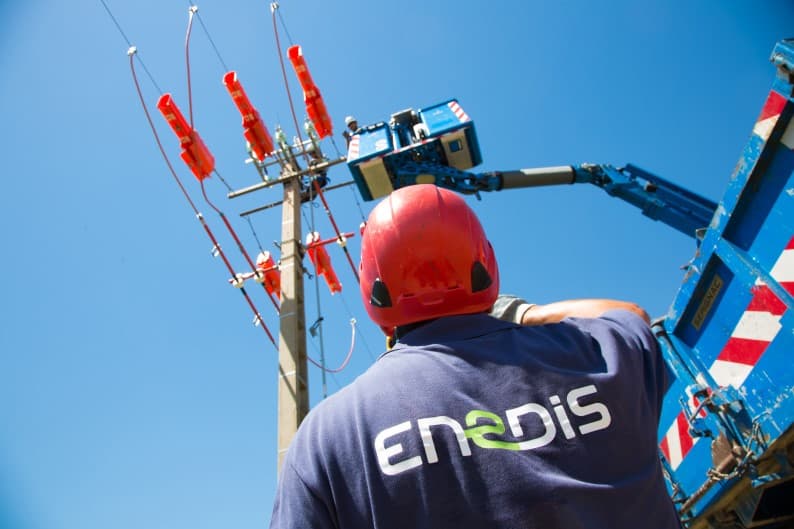
Unified steering across eight regional divisions
42 Power BI dashboards · data under 15 minutes old
A national field-intervention estate split across eight regional divisions. With no unified steering tool, each division ran its own spreadsheets and reports, making national consolidation slow.
A shared data visualisation layer that replaces the daily batch: SLA drift becomes visible as it happens, load can be shifted between neighbouring divisions, and seasonal peaks are anticipated instead of absorbed.

Interactive supervision for rail maintenance workshops
8 workshops in production · zero regression
Maintenance workshops spread across the region needed modern interactive supervision to steer interventions and anticipate failures. The existing tooling was legacy: no real-time view, no shared display, no quality gate on releases.
Test and reporting applications designed from scratch, built into the maintenance teams' processes, with a quality gate on every change: 68 trainsets supervised and no regression in production.
Six Audits
To secure your AI strategy.
EU AI Act compliance audit
Risk classification (minimal, limited, high, unacceptable), technical documentation compliant with Annex IV, data governance aligned with European standards.
Security & robustness audit
AI red teaming, pipeline audit, securing model access and secrets, for AI platforms that hold up in production.
Ethics & explainability (XAI)
Bias detection and correction, operational explainability (SHAP, LIME, reasoning) and an AI ethics charter tailored to your organisation.
Performance & ROI audit
Cost, performance and latency analysis, architecture optimisation (sizing, quantization, caching), audit of real business impact.
Data governance strategy
Data privacy policy (GDPR, trade secrets), structuring of flows and lineage, data quality audit and data contracts.
Support in selecting tools
Benchmark of AI solutions, vendor sovereignty audit, support for the Build vs Buy decision.
From idea to production
Discover
depending on scope, sector and the level of compliance required
- Audit of use cases and pain points
- Value / feasibility matrix
- Executable specification (ASDD)
MVP
depending on system complexity and integrations
- An agent in a real environment
- Generated tests, measured coverage
- Go / no-go before industrialisation
Scale
depending on the number of agents and connected systems
- Multi-agent orchestration on a shared foundation
- CI/CD and MLOps integration
- Team upskilling
Run
service commitment defined with you
- LLMOps observability
- FinOps optimisation of AI costs
- Continuous compliance audit
Why an AI Strategy, Today?

Stay ahead of the EU AI Act, GDPR and sector standards. Secure your markets and demonstrate your compliance to regulators and auditors.
Detect and eliminate bias in your models. Make decisions reliable with guardrails, inference traceability and continuous drift monitoring.
Protect your sensitive data and intellectual property against AI-specific threats: prompt injection, exfiltration, model inversion, supply chain.
Identify algorithmic inefficiencies, adjust the sizing of your models and manage inference, training and cloud infrastructure costs.
Insights & Perspectives

The five dimensions of AI adoption
A five-dimension framework, literacy, engineering, champions, governance and playbook, to turn generative AI adoption into lasting business value.

The Seven Deadly Sins of AI Transformation
Seven deadly sins explain why most AI transformations fail: aimless data hoarding, overconfidence, copycat strategies, sacrificed ethics.

Start smarter: identify your transformation exemplar
How to pick the right digital transformation exemplar: a discovery phase, three decision lenses (impact, feasibility, relevance), and team mobilization.
After the framing
 Expertise
AI Agents
AI agents that reason, decide and act, orchestrated and governed in production.
 Expertise
GenAI Platforms
A CIO organisation augmented by GenAI: sovereign RAG, LLMOps and governance at scale.

Define your AI strategy
A maturity assessment, your priority opportunities, a clear roadmap.
Frequently asked questions
With a discovery phase that maps use cases, data and regulatory constraints, then ranks them on three lenses: business impact, technical feasibility, and relevance to your context. What comes out is a shortlist you can defend, not a wish list.
Framing takes 2 to 6 weeks depending on scope, sector and the level of compliance required. AI Discovery is its short format, four weeks on a fixed scope, one step per week. Either way it ends with a prioritised roadmap and a first use case ready to build, not with a slide deck.
Six angles: data and its governance, existing engineering practices, the technical foundation, team skills, regulatory compliance, and the use cases already under way. Each one is scored, so the gap to close is explicit.
Rarely for technical reasons. The recurring causes are data hoarded without a purpose, use cases copied from competitors without fit, no governance decided upfront, and a proof of concept that no one designed to reach production.
No. Adoption rests on five dimensions: literacy, engineering, internal champions, governance and a shared playbook. Skills are built as the first use cases ship, with your teams involved rather than replaced.
By classifying each use case by risk level at the framing stage, keeping a register of authorised models and tools, and making decisions traceable. Compliance decided upfront costs far less than compliance retrofitted.
On indicators chosen before the build, tied to the business process concerned: cycle time, error rate, volume handled, team satisfaction. A use case with no baseline measured beforehand cannot be assessed afterwards.